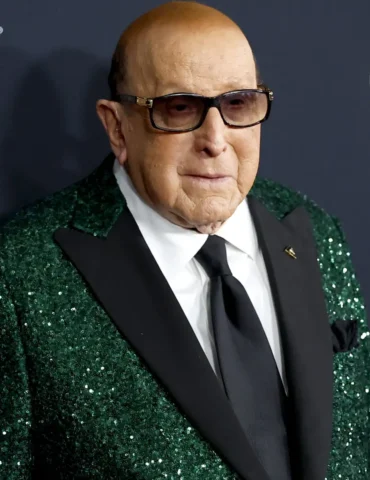
The music industry has lost one of its most influential architects. Clive Davis, the legendary record executive whose vision helped shape the careers of some of the biggest names in music history, passed away Monday at his Manhattan home at the age of 94.
For more than six decades, Davis stood behind the scenes, discovering talent, building careers, and helping create some of the most memorable moments in popular music. While artists often occupied the spotlight, Davis became one of the rare executives whose name carried nearly as much recognition as the stars he helped create.
Born in Brooklyn, New York, on April 4, 1932, Davis’s journey to music industry greatness was anything but conventional. A brilliant student, he attended New York University on a full scholarship and graduated magna cum laude before earning another scholarship to attend Harvard Law School. Armed with a law degree, he joined Columbia Records in 1960 as legal counsel, a move that would ultimately alter the course of popular music.
By 1967, Davis had risen to president of Columbia Records, where he demonstrated an uncanny ability to identify groundbreaking talent. Under his leadership, Columbia signed or developed artists who would become cultural icons, including Janis Joplin, Santana, Billy Joel, Blood, Sweat & Tears, Chicago, Bruce Springsteen, and Pink Floyd.
Although his tenure at Columbia ended abruptly in 1973 amid allegations involving company expenses, Davis’s impact on the industry was far from over. In many ways, his second act would prove even more influential.
At Arista Records, Davis built one of the most successful label rosters in music history. He nurtured the careers of established legends such as Aretha Franklin and the Grateful Dead while introducing audiences to future stars including Patti Smith, Annie Lennox, Air Supply, and Kenny G.
Perhaps no artist was more closely associated with Davis’s legacy than Whitney Houston. Recognizing her extraordinary talent early on, Davis carefully guided her development into one of the best-selling and most beloved singers of all time. Houston’s meteoric rise became one of the greatest artist-development success stories the music business has ever seen.
Davis also played a crucial role in expanding the influence of R&B and hip-hop. His partnership with Antonio “L.A.” Reid and Kenneth “Babyface” Edmonds led to the success of LaFace Records, the label that launched or elevated the careers of TLC, Toni Braxton, Usher, and OutKast. Through these collaborations, Davis helped define the sound of an entire generation.
Never content to slow down, Davis launched J Records in 2000 with substantial backing from BMG. Once again, his instincts proved remarkable. The label’s breakout artist was Alicia Keys, whose debut album became a global phenomenon. J Records would also become home to artists such as D’Angelo, Monica, Jamie Foxx, and Luther Vandross.
What set Davis apart was not simply his ability to sign talent—it was his ability to recognize greatness before the rest of the world did. He possessed an extraordinary understanding of artists, songs, and audiences, helping bridge generations and genres from rock and pop to R&B and soul.
His contributions earned some of the music industry’s highest honors. Davis received the Recording Academy’s Trustees Award in 2000 and the President’s Merit Award in 2009. That same year, he was inducted into the Rock & Roll Hall of Fame as a non-performer, a fitting recognition for someone whose influence extended across nearly every corner of popular music.
From Janis Joplin and Santana to Whitney Houston and Alicia Keys, Clive Davis leaves behind a musical legacy measured not only in record sales but in the countless artists whose careers he helped launch. His story serves as a reminder that behind every great artist is often someone who believed in them first.
As the music world reflects on his remarkable life, one thing remains clear: Clive Davis didn’t just discover stars—he helped shape the soundtrack of modern music.
 play_arrow
 play_arrow







 DOUG SIMS LIVE PODCAST